
That dark line along the skirting board isn’t dirt you walked in.
It is the carpet straining air — and it is the one mark a vacuum will never touch, no matter how many times you go over it.
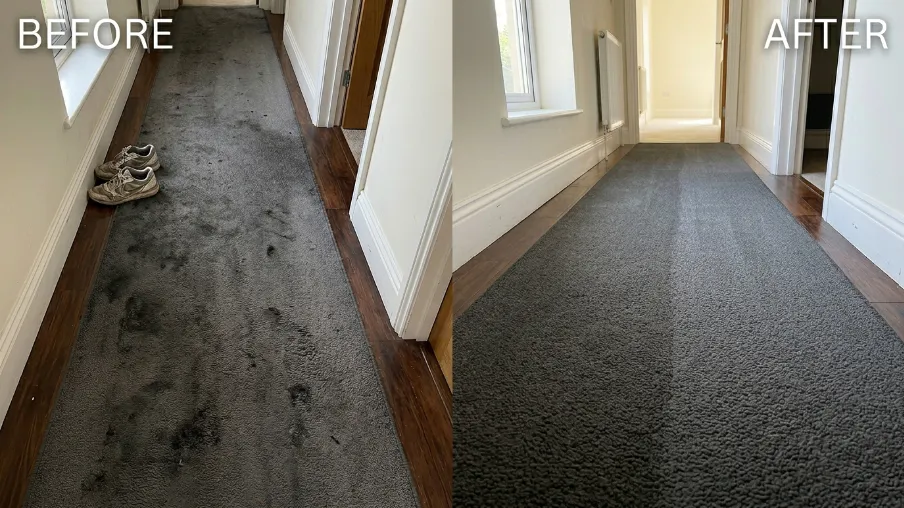
South Clean cleans carpets, upholstery, rugs, mattresses and curtains across Cranbourne West, Lynbrook, Lyndhurst and Skye — settled family homes and newer estates alike, nearly all of them with ducted heating.
Book your Cranbourne West clean
Tell us the rooms, and mention any dark lines at the skirting or under doors.
Why the edges go black while the middle stays fine
It is one of the most common calls we get, and almost nobody guesses the cause correctly. A sharp grey or black band appears right where the carpet meets the skirting board, or in a stripe under a bedroom door, or in a neat arc around a heating vent. Meanwhile the middle of the room — the part everyone actually walks on — looks clean.
If it were foot traffic, it would be the other way around. What is really happening is that air is being pulled through the carpet at those points, and the carpet is doing what any fibrous mat does when air passes through it: it filters. Ducted heating and cooling push air into a room, and it has to get out again. It escapes through the small gaps — the tack strip gap under the skirting, the clearance under a closed door, the join around a vent — and it takes the room’s airborne particles with it.
Those particles are the ultrafine ones: soot from candles and cooking, smoke, road particulates, fine dust. They are far too small and light to fall onto the floor on their own, so they float indefinitely — until air carries them through a strip of carpet, where the fibres strain them out. The line is sharp for the same reason a filter mark is sharp: the air is only passing through in that one narrow place.
This is why the mark builds where the room is closed more often, and why it is usually worst in bedrooms that get the door shut and the heating on all winter.
Where to look for it in your house
Five places filtration lines show up, in roughly the order people notice them.
A grey band 1 to 3cm wide following the wall, usually worst in bedrooms that get the door closed. Sharp on the wall side, fading towards the room.
A clean stripe of darkening exactly the width of the doorway. Air squeezing under a closed door moves fast, so it concentrates there.
A halo or arc on the supply side. If the ducting itself is dusty, this one darkens noticeably faster than the rest.
The front edge of each tread has a gap behind it, so the same effect appears as a line along the lip of every step.
Anywhere with a narrow gap between furniture and floor, air funnels through and leaves the same deposit.
Candle and cooking soot are among the finest particles in a home, which makes them the classic feedstock for filtration lines.
Why vacuuming never fixes it — and what does
Two reasons. First, the particles are ultrafine and have been driven into the fibre by moving air, not dropped on top of it, so surface suction has nothing loose to collect. Second, no upright vacuum reaches the last couple of centimetres against a skirting board anyway, which is exactly where the deposit is heaviest.
Removing it is a separate step from cleaning the room, and it is done by hand: a targeted pre-treatment worked into the edge, dwell time to release the bonded soot, then extraction with a small hand tool along the line rather than the main wand. It is slower than the rest of the job, which is why plenty of cleaners simply run the wand past and leave the line there.
Stopping it coming back
The rest of the clean
Edge lines are the speciality here, but the standard job is the same one every Cranbourne West home needs: a dry pre-vacuum to lift grit out of the base of the pile, pre-spray and agitation through the traffic lanes, then hot water extraction to flush out the oily film that suction cannot touch. Newer estate homes also carry fine plaster and render dust deep in the pile from the build, and because that dust is gritty, getting it out early is the most valuable clean the carpet will ever have.
Why Cranbourne West books South Clean
Filtration lines pre-treated and extracted with a hand tool, not skipped.
From $40 a room, quoted before we start. No call-out fee, no suburb surcharge.
Dry pre-vacuum before any moisture, because wetting grit only drives it deeper.
If a line will only reduce rather than clear, you hear that at the quote.
Every technician, every job.
Longer in cold or humid weather. Rooms back in use the same day.
How booking works
Three steps, no all-day waiting window.
Bedrooms, living areas, stairs, plus any edge lines you have noticed.
Quoted upfront with a real time window.
Vacuum, pre-treat, extract, then hand-work the lines. Dry in hours.
Other services in Cranbourne West
Cranbourne West & surrounds
See all south-eastern suburbs or browse every area we serve.
Cranbourne West carpet cleaning — FAQs
What causes the black line along my skirting boards?
Filtration soiling. Ducted heating and cooling push air into a room and it escapes through small gaps – the tack strip gap under the skirting, the clearance under a closed door, the join around a vent. The carpet at that point acts as a filter and strains ultrafine particles like candle and cooking soot out of the passing air. The line is sharp because the air only passes through in that one narrow place.
Why is the edge dirty when the middle of the room looks clean?
Because it is not foot traffic. If walking caused it, the middle of the room would be the worst part. Filtration lines appear where air moves through the carpet rather than where feet do, which is why they are usually worst in bedrooms that get the door shut with the heating running all winter.
Why will not my vacuum remove it?
Two reasons. The particles are ultrafine and have been driven into the fibre by moving air rather than dropped on top of it, so there is nothing loose for suction to collect. And no upright vacuum reaches the last couple of centimetres against a skirting board, which is exactly where the deposit is heaviest.
Can filtration lines be removed?
Most lift substantially and many clear completely, but it is a separate hand-worked step: a targeted pre-treatment into the edge, dwell time, then extraction with a small hand tool rather than the main wand. Lines that have been building for ten years or more sometimes only reduce, because very fine soot can permanently stain the fibre. We will tell you which one yours is before we quote.
How do I stop the lines coming back?
Change your heating and cooling filters on schedule, leave doors ajar rather than fully shut where you can, burn fewer candles and not near a doorway, and run the rangehood during and after cooking. If the halo around a vent returns quickly, have the ducting checked.
How much does carpet cleaning cost in Cranbourne West?
From $40 a room, quoted upfront before we start. Stairs are charged separately. There is no call-out fee and no travel surcharge between Cranbourne West, Cranbourne, Cranbourne North, Lynbrook, Lyndhurst, Hampton Park and Skye.
How long will the carpet take to dry?
Usually 2 to 4 hours, extending to 6 to 8 hours or longer in cold or humid conditions. That is an estimate rather than a guarantee. Before we leave we will tell you which windows and fans will get it dry fastest.
Get the edges done properly
Full clean plus hand-worked filtration lines. From $40 a room, quoted upfront.