How Often Should You Clean Your Upholstery? A Melbourne Homeowner’s Guide
Most people clean their carpet and never think about the sofa — despite spending several hours a day sitting on it. Here’s how often upholstery actually needs doing, and the signs that it’s overdue.
How often, by household
There’s no single right answer, but this is roughly what different homes need.
| Household | Clean every |
|---|---|
| Couple, no pets, sofa used lightly | 18–24 months |
| Family with children | 12 months |
| Pets allowed on the furniture | 6–12 months |
| Someone with asthma or allergies | 6–12 months |
| Second-hand couch, before first use | Straight away |
What’s actually in your sofa
Fabric holds things carpet doesn’t, because of prolonged skin contact. Body oils transfer continuously from skin and hair into the fabric, especially on armrests and headrests, and they slowly darken it. Because it happens evenly across months, most people never see it happen — they just notice one day that the sofa looks tired.
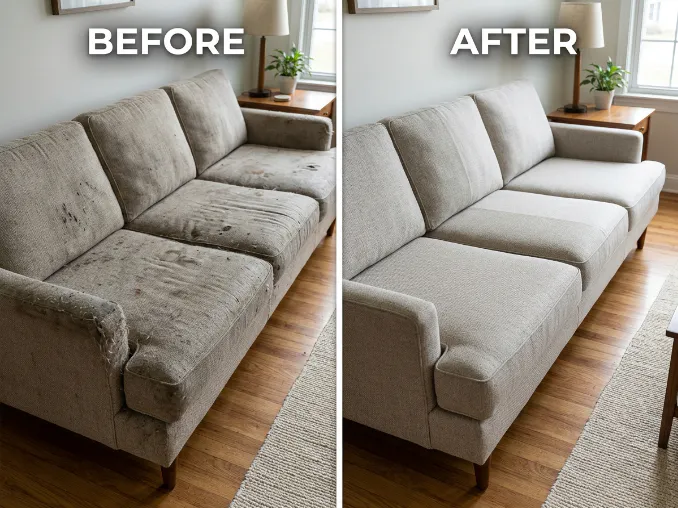
The giveaway is under a cushion. Lift one and compare the fabric underneath to the exposed surface next to it. That difference is what a clean removes, and it’s usually a shade or two.
Signs it’s overdue
- Armrests and headrests are visibly darker than the rest
- A faint musty smell when you sit down, or when the room’s been shut up
- Allergy symptoms worse in the lounge room than elsewhere
- The fabric feels slightly tacky rather than dry
- Pet hair worked so deep into the weave that vacuuming leaves it behind
Why DIY usually disappoints
Upholstery is less forgiving than carpet. Carpet sits on a floor; upholstery is fabric stretched over foam and frame, so anything you apply has nowhere to drain and everything you use has to come back out.
- Too much water soaks into the foam, which then takes days to dry and can develop a smell far worse than what you started with.
- Supermarket sprays leave residue that attracts soil, so the cleaned patch ends up dirtier than the fabric around it.
- Rubbing breaks the fabric surface and creates a permanently fuzzy patch that catches light differently.
- No fabric test is the big one — some fabrics watermark from plain water alone, and velvet, linen and bouclé each behave differently.
Between professional cleans
- Vacuum weekly including under and behind the cushions, where crumbs and hair collect
- Blot spills immediately with a dry cloth — press, don’t rub
- Rotate and flip cushions so wear spreads evenly instead of forming one sunken seat
- Keep the sofa out of direct sun, which fades fabric faster than use does
- Ask about fabric protection at your next clean if the couch takes heavy use
Sofa looking tired?
Fabric tested first, cleaned safely, dry in hours. From $40 per seat, quoted upfront.
Related reading: our 2026 price guide, pet stains and odours, and mattress cleaning — worth doing in the same visit.